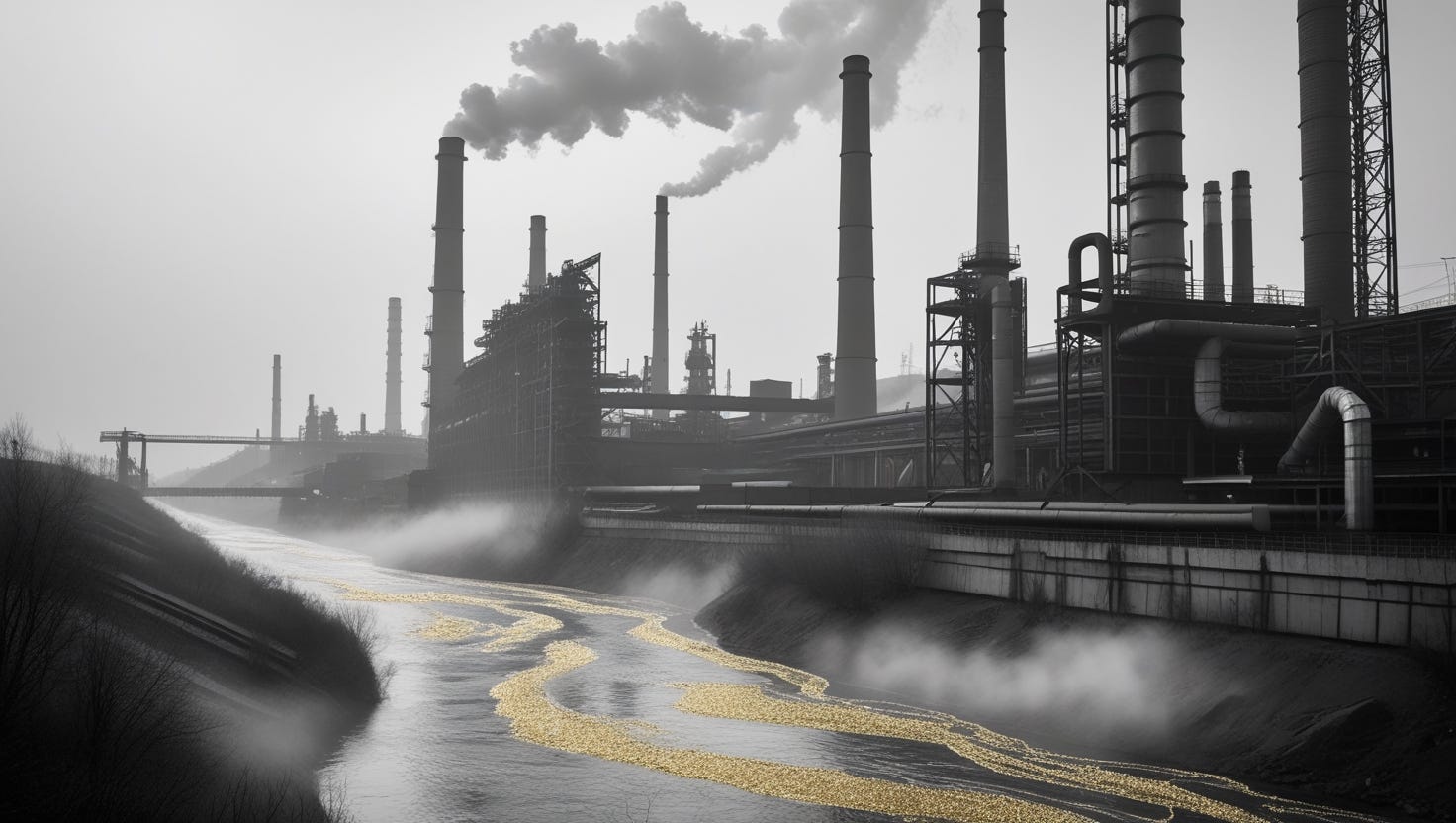
Turn My Waters Into Profits, Beckoned the River. Nope, Said the Steelmaker.
How to make sense of (seemingly) nonsensical connections between finance and sustainability
In the industrial economy, water is often treated as a passive input. Something you use, account for, and discharge—ideally with some level of treatment. Rarely does it speak.
But what if it could?
What if water could tell you when your profits were about to fall? What if it could whisper, “You're taking too much... and it's costing you.”
This isn’t a metaphor. It’s a question my team and I have been exploring at Wangari Global. My premise, when I started my company, was to bridge the worlds of finance and sustainability. Now, with my two fantastic cofounders, we’ve been able to dig deeper: Causality is perhaps the missing link between finance and sustainability. What if the two are not just connected, but actually cause one another?
Let’s start with a real example: ArcelorMittal, one of the world’s largest steelmakers. In reviewing twelve years of their sustainability and financial data, we noticed something strange. The more groundwater they extracted in a given year, the lower their profits tended to be.
The correlation: -0.26. Its corresponding p-value told us that this was not a spurious correlation either.
It’s not a smoking gun. But it is a signal—especially when you start to see sustainability and financial indicators not as separate silos, but as interdependent threads in a complex system.
So we asked: Is this just noise? Or is water trying to tell us something?
The Trouble With Coincidences
Financial analysts are trained to spot patterns—but also to distrust them.
Most analysts don’t even go as far as digging into correlations between financial and non-financial variables. A couple of large investment banks had actually told me that my correlations alone would be worth a lot of money for them.
Those investment bank deals never happened—largely because of my own complicated feelings about making money, which I still was struggling with at the time. (I’ve found the tools and resources, thankfully, to release many of my limiting beliefs that stemmed from a weird childhood. Not great to harbor such misguided beliefs when you’re an entrepreneur—but that’s a story for another day).
Moving on from those deals that never happened, my cofounders and I decided to dig deeper. A weird correlation is cool, but is it also indicative of a causal relationship?
A correlation might catch an analyst’s attention, but it doesn’t tell you what’s actually happening: Is water extraction driving profit down? Or is falling profit prompting operational overreach, including excessive water use? Or is a third variable—like heatwaves or outdated equipment—affecting both?
In other words, we’re not just asking what happens. We’re asking what causes what.
Most financial models aren't designed to answer that. They optimize based on historical fit, not causal logic. As long as the predictions work, the model is considered useful.
But systems thinking—and long-term investing—demands more.
Because when inputs and outputs are part of a living, dynamic ecosystem, you need to understand the relationships that hold it together. You need to know which links are strong, which ones are strained, and which ones are quietly snapping.
The end result, of course, are more robust financial models that don’t just generate higher returns immediately but also stand the test of time. But I’m getting ahead of myself.
Steelmaking as a System
Let’s think in systems for a moment.
In a steel plant, water isn’t just a cost factor. It cools blast furnaces, removes impurities, prevents dust explosions, and sustains the plant’s thermal balance. It’s not secondary. It’s essential.
And like all systems, a steel factory has feedback loops.
Use too little water, and your production quality may suffer.
Use too much, and you might incur fines, resource depletion, or community backlash.
Fail to track the thresholds, and you end up overspending—or worse, overstepping environmental limits that later come back as liabilities.
Now extend the lens. ArcelorMittal operates in multiple geographies, each with its own hydrological, social, and regulatory context. Water extraction may be legally permitted but politically sensitive. It may be cheap today but scarce tomorrow.
That’s the point where sustainability becomes financial. In fact, it always has been financial, but in an ever-complicating world I believe this relationship will just get more pronounced.
If your operations depend on a resource that’s becoming more volatile—whether that’s water, labor, or land—you’re not just facing reputational risk. You’re facing operational risk, pricing risk, and eventually valuation risk.
From Patterns to Pathways: Enter Causal Thinking
So what do we make of that -0.26 correlation?
On its own, not much. It’s large enough, and you can probably make some nice trading models off this alone. You can probably generate some alpha with it in the short term. But to be honest I’d be hesitant to make major financial bets on this one number alone.
What’s cool about this correlation is that it’s indicative of a larger story. And this story we can now begin to unpack.
At my firm Wangari, we’ve (painstakingly, with lots of trial and error) developed methodologies around causal inference to turn surface-level correlations like this one into structured hypotheses. We’ve figured out that this means:
Building causal graphs to map out how different variables might influence each other
Using statistical techniques to test whether changes in water use precede (and not just coincide with) changes in profit
Controlling for confounders like steel prices, input costs, climate variations, and regulatory shifts
The goal isn’t just to “prove” that water causes profit decline. The proof is in the p-value from the correlation, and some major investment banks were interested enough in this alone! But it’s not enough for us.
Our goal is to understand the structure of the system itself—instead of trading on surface-level observations (groundbreaking they may be), we can understand exactly why water consumption causes lower profits or vice versa, so that we can identify the knobs along the value chain that allow decision-makers to make more profit while preserving the environment, now and in the long term.
Sometimes, the causal link holds. Sometimes, it dissolves under scrutiny. But even when it doesn’t, the process of questioning the link is where the insight lies.
Those insights, we hope, will be even more interesting to investment banks, hedge funds, industrials, policymakers, and many more actors in the field. At this stage, we’re frankly still figuring out who’d benefit most from our methodology.
Also, we’re still working on automating our entire workflow with AI agents and LLMs to make it available to as many users as possible. (More on that sometime in the coming weeks and months!) But I’m already starting to feel glad that we didn’t become a correlation-calculator for investment banks, because this digging deep into causal relationships, frankly, feels a lot more fulfilling.
Coming Up: The Causal Path from Water to Profit
This Friday on Wangari’s technical blog, we’ll walk you through our causal analysis of the ArcelorMittal case.
We’ll show:
How we built the causal graph
What methods we used (with code!)
What the data actually revealed about groundwater use and profitability
If you’ve ever wanted to see causal inference applied to real-world sustainability data—not just theory, but practice—this will be a case study worth reading.
Until then, listen to the signals. Sometimes, even water has something to say.
Wangari’s Curated Reads
Digging deep into the steel industry this week, it seems that automation in steel manufacturing still has limits. Andy Lubershane shares that jobs requiring manual dexterity—like linemen and plumbers—are among the toughest to automate, even with today’s AI advancements. The article highlights how the unmatched complexity of human hands and the energy efficiency of human brains make replicating physical labor through robotics a formidable challenge.
This episode of by The Marvelous Mrs. Metals explores a pivotal policy dilemma in the U.S. steel industry: whether to invest in modernization or double down on trade protection. The failed Steel Modernization Act, which aimed to foster green, efficient domestic production, contrasts with the steep escalation of tariffs that protect existing producers but risk stalling innovation and increasing emissions. This is a sharp reminder that shielding old industries without transformation could cost us more than we realize.
This dispatch from the Steel Trader’s Journal offers an in-depth look at the covert chaos unfolding in Europe’s steel market. Prices are diverging, imports flooding in before new carbon rules hit, and enforcement holes are big enough to drive coils through. The game is now about timing, routing, and reading policy tea leaves. Even in an era of green talk, steel still flows where rules are weakest and margins are thinnest.