



A few months ago, my team showed a client some AI-generated regulatory reporting. We were proud of it — the output was sophisticated, which is exactly why we put it in front of them. The client looked at it and said, more or less: “This is highly sophisticated garbage. It sounds nice, but we don’t even know what it means.”
He was right. And in our line of work, that sentence is a serious problem — because what we do is financial reporting, and in financial reporting a mistake doesn’t just cost money. It can get you into jail.
That was one of the more humbling moments of my career. I’ve spent the better part of a decade building machine learning and AI systems — in particle physics, in weather insurance, and most recently in financial reporting. I know what these models can do. After that meeting, I also knew, viscerally, what they must never be allowed to do.
So we turned around and built something different. For ten years my instinct had been to take humans out of the loop — automate more, decide more, need people less. This time I did the opposite. I put humans deliberately back in.
The reason the temptation exists
Anyone inside this world knows financial reporting is ripe for automation. The work is repetitive, it comes around every reporting season, and yet it demands real skill — you can’t hand it to just anyone. It has to be done by highly paid professionals who, frankly, would rather be doing almost anything else.
That’s the promise our product, etio, delivers on. It cuts the reporting cycle from three or four days per team, per season, down to a few hours. Honestly it can do it in minutes — but with the normal sign-offs and deep dives, we conservatively say hours. Either way, that’s roughly 97% of the time gone.
Here’s the catch, and it’s the whole story: AI hallucinates. Large language models are non-deterministic by definition, which is a technical way of saying they sometimes just get things wrong. Cutting the time and producing beautiful reports is the easy part. The real question — the one that keeps a CFO up at night — is what you do about the mistake that will, sooner or later, appear.
Our answer isn’t “trust the model”
It has two parts, and neither of them is “trust the model.”
First, we don’t let the AI invent numbers. We pre-calculate the facts — the actual figures — with old-fashioned, deterministic code. Not AI. Code. The language model never gets to make a number up; it only ever gets to talk about numbers that were already computed and checked.
Second, we put a human at two specific gates in the workflow. At each gate, a person reviews what the machine produced and either approves it or corrects it. Nothing moves past a gate on the machine’s say-so alone. In an era where every AI pitch is about removing the human, we deliberately kept two of them — and made their signature the thing that unlocks the result.
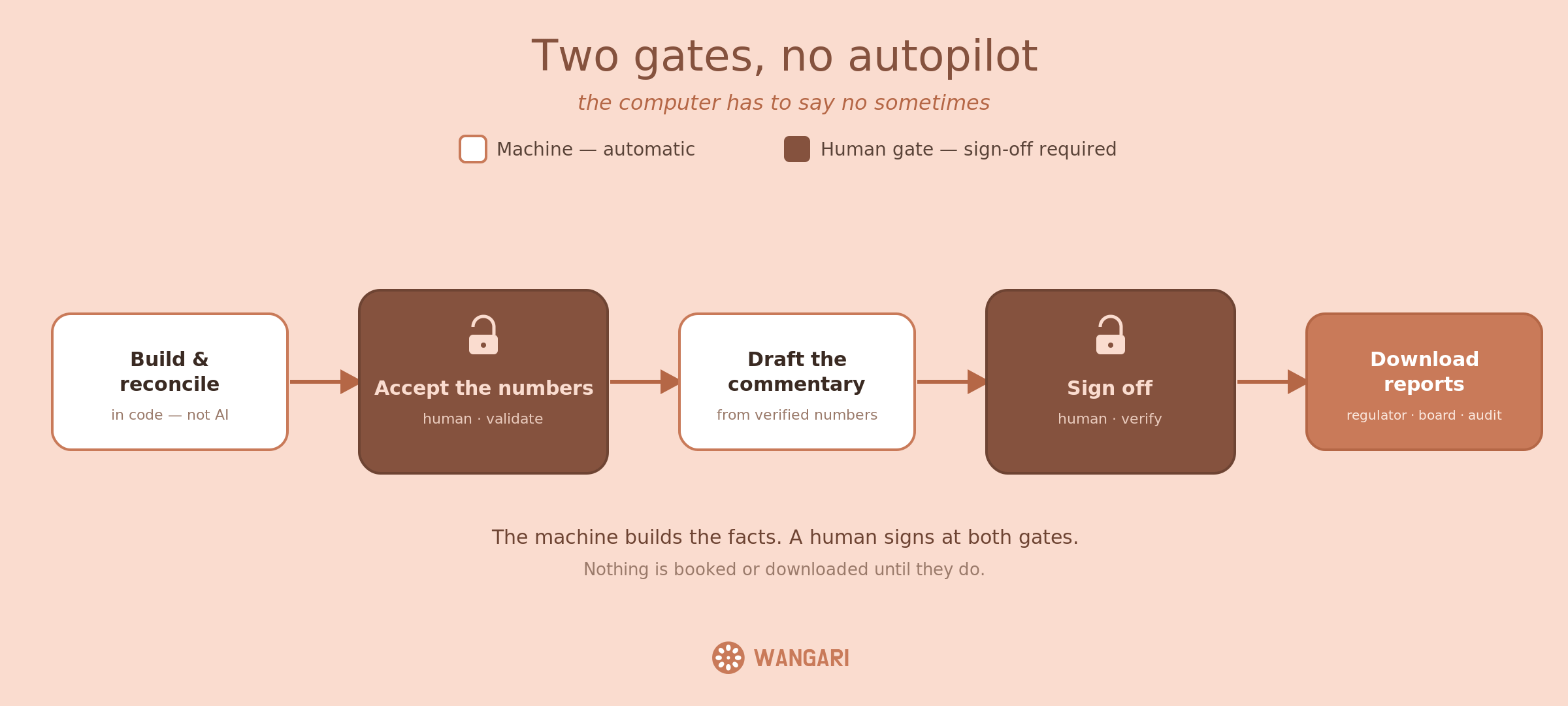
That’s what I mean when I say the computer has to say “no” sometimes. The most important thing etio does isn’t generate — it’s refuse. It refuses to state a number it can’t back, and it refuses to finish without a person.
Where this gets exciting: data!
Automating a dull process might sound like dull work. It isn’t — and this is where it gets genuinely interesting.
The data that reporting runs on is a goldmine. Every season, enterprises painstakingly pull it together from every corner of the business — and then underuse it. Their data scientists exist, but they’re not pointed at this. Silos and legacy systems keep the most interesting signal buried. But by the time you’ve finished a close, all of that data is finally sitting in one place, clean and reconciled. So we step in and do something more with it.
Once the reporting itself becomes almost trivial, you can use the same data to enhance human judgment. And I don’t mean the reporting team’s judgment — I mean the executives’. Because who actually reads financial reports? Executives do. And what do they do with them? They set corporate strategy. They brief their boards. They answer to regulators. The report isn’t the end of the process; it’s the input to every important decision the company makes.
So etio takes that reconciled dataset and surfaces the strategic insight sitting underneath it — using techniques that go well beyond a standard data scientist’s toolkit, drawn from my decade across particle physics, weather insurance, and sustainable finance. The most important of these is causal inference: not just what happened, but why. The reporting pays the bills — you have to do it anyway. But those extra insights are the gold. They’re what actually moves the company forward.
What it looks like in practice
Say we’re closing Allianz — a large German insurer — on last year’s numbers.
The user does almost nothing: click new close, then start close. Behind that click, the machine works hard. It identifies the reporting standard — for Allianz, IFRS 17 — builds the facts and reconciles them under that standard, and then hands every calculated number to a human.
That person might be a controller, a data manager, or an actuary. They review: Is this plausible? Does it make sense? They can recompute a figure by hand, run their old Excel against it, whatever they trust. If they’re satisfied, they click accept.
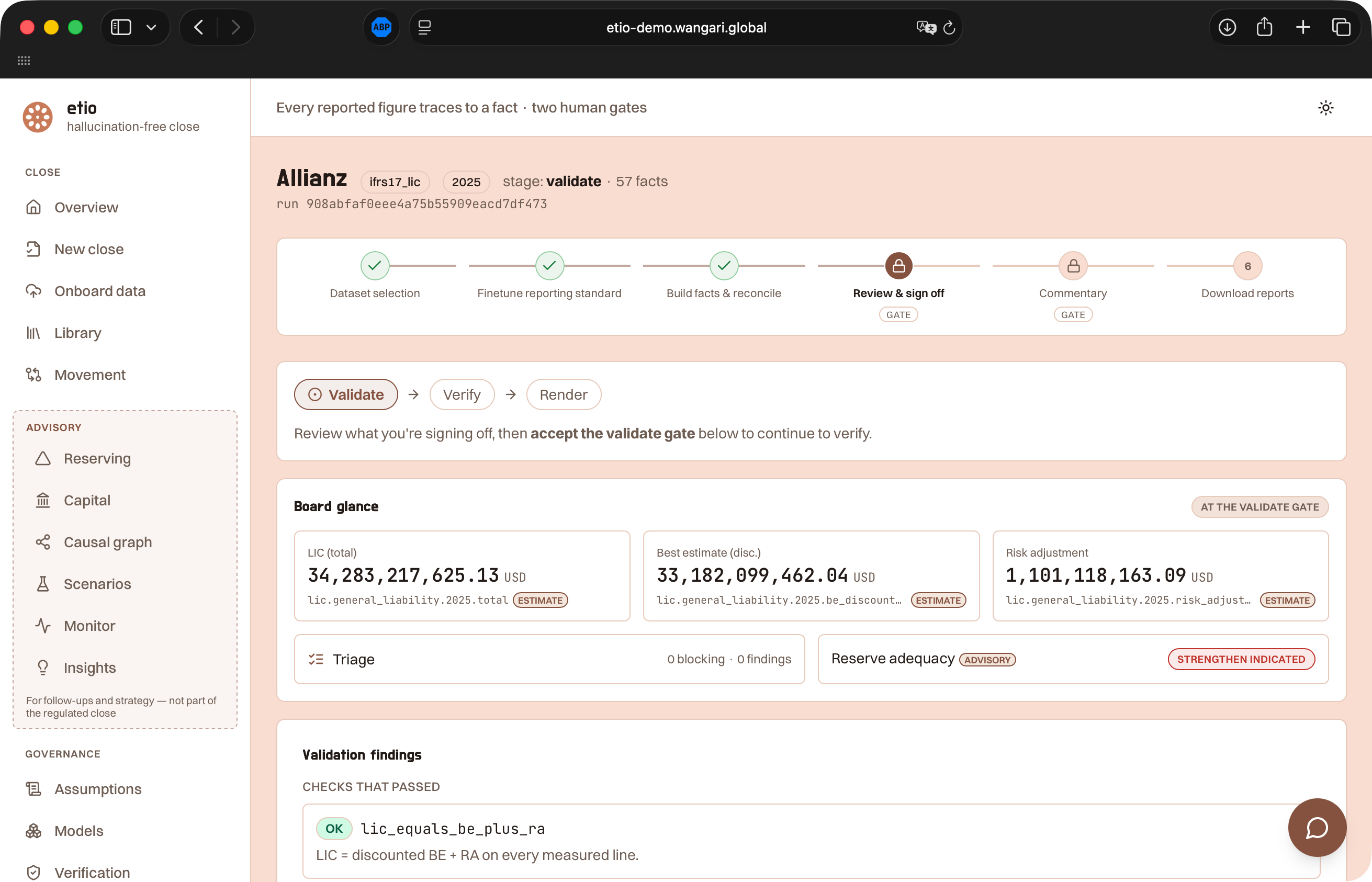
That’s the first gate, the one that goes against all the automation talk.
The second gate is for the commentary. Every regulatory report needs prose — words that explain what the numbers say. etio drafts that commentary with a fairly sophisticated suite of LLMs and agents, but it composes it only from the numbers already calculated, which is exactly how we keep hallucinations out. The human reviews it, edits it if they like, and signs it off.
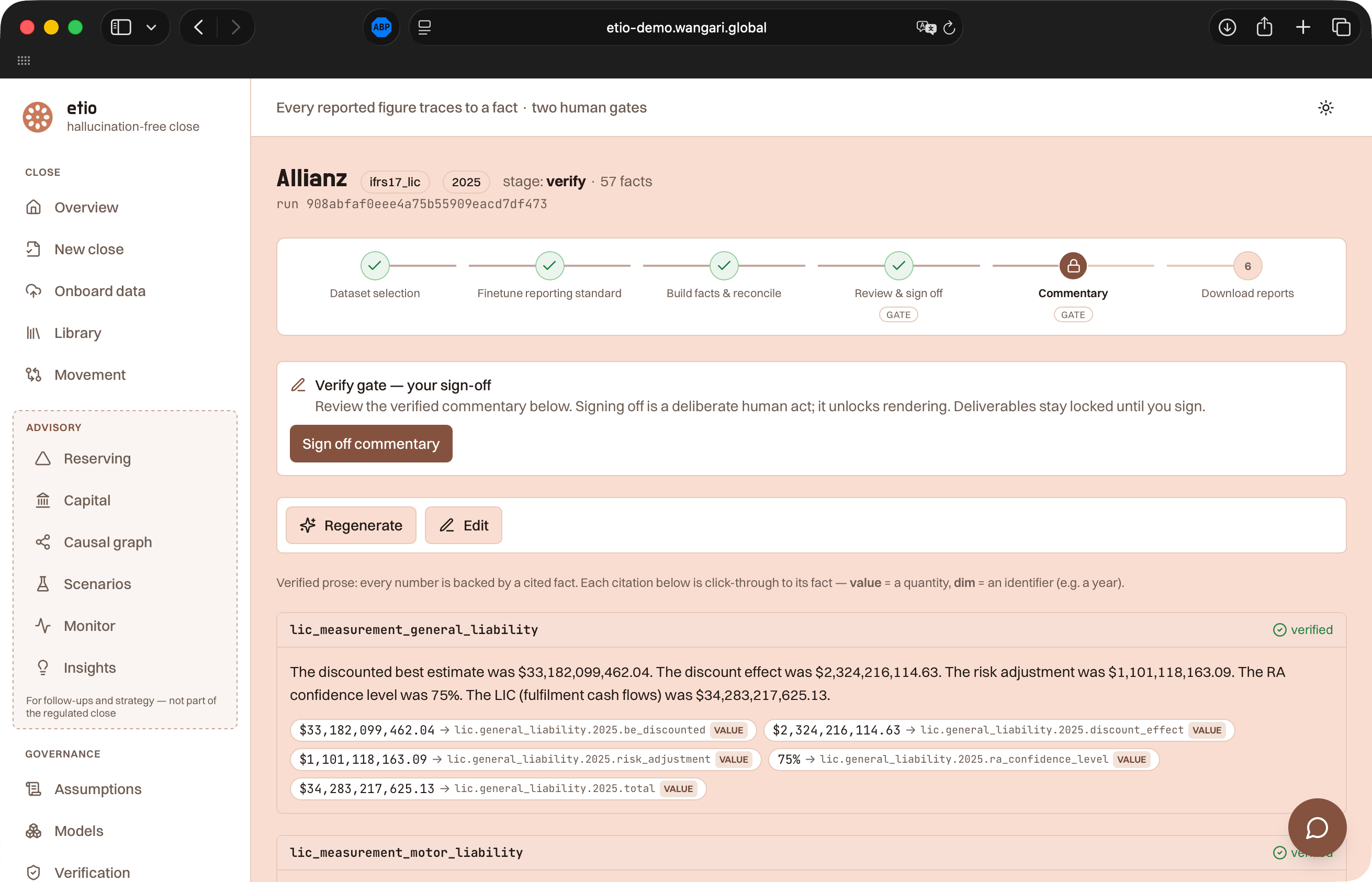
Whole teams can work this way with etio, with responsibilities split across roles. Then, finally, you simply download the reports.
The really meaty part: follow-up questions
From there it opens up. You can ask an AI assistant — with the administrator’s permission — the questions you actually have: “I don’t understand this number, how did it come about?” or “Why did this move so much versus last year? What changed?” And the answers, like everything else, are hallucination-free.
And then you can look at the crown jewel: the causal graph. It’s a chart that shows what causes what, and by how much. In insurance, for instance, rising loss costs — more claims, or bigger ones — feed into frequency and severity, which in turn drive the loss ratio. Those relationships can now be quantified mathematically and tested statistically: is this actually true, or not?
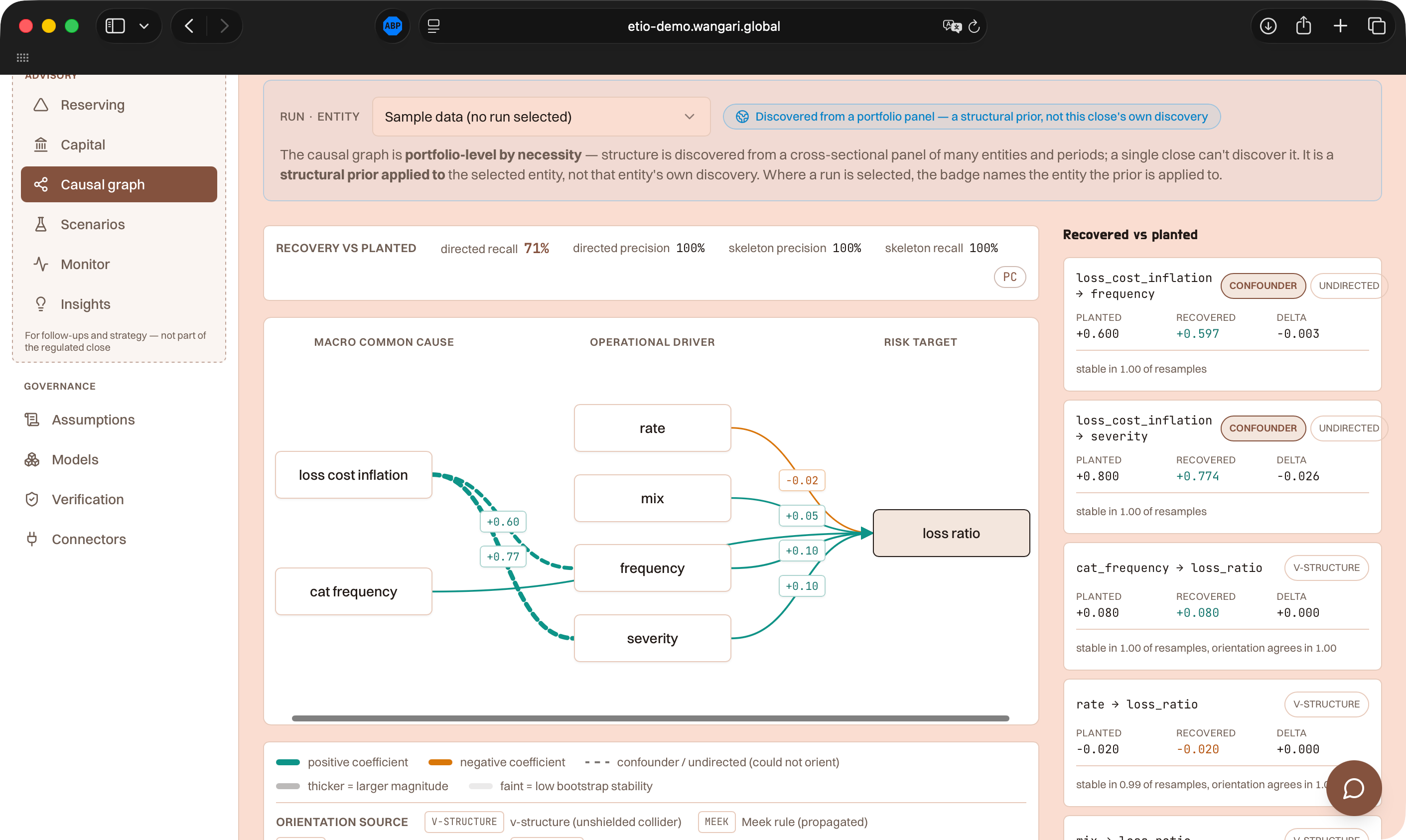
Building such causal graphs, at scale, wasn’t really possible before this era of AI. It’s no longer just seasoned human intuition; it’s computation.
None of it is a regulatory requirement. But it guides strategy, and it answers the follow-up questions — because regulators are humans too, and humans ask why. Sometimes they ask more than they strictly should. So it’s good to have the answer ready.
Our vision for this
This etio today. It saves enterprises 97% of boring-work time. But the vision is bigger than a faster close.
Imagine you had this picture across many enterprises — how each one acts in its environment, and what that does to it. You could tell a company, with evidence, what it should do to genuinely thrive. That’s the end goal of Wangari: to show that acting in a certain way lets you prosper — not only as an enterprise, but for your customers too.
And that starts with one honest close.
Because in the end, this is the whole point: systems that serve humans, not the other way around. We build machine learning and AI to serve people — which means people have to keep their place in the workflow, at every step. That isn’t a limitation. That’s the design.
Meanwhile, at Wangari
Today is a slightly different “meanwhile” section than usually. Really, it’s a housekeeping note.
We will be pausing the Friday podcast for now because I’ve come to realize that me rambling alone in a room is probably not the best use of everybody’s time. I’m now working on lining up valuable guests for a future podcast relaunch (as a dialogue, not a monologue).
I can’t give you a date for that just yet though, because as you can see, we’re quite busy building etio already 🙂
So, for now, we’ll have just the Tuesday newsletter. And you’ll miss me on the Tuesdays of August 11 and 18, while I’m busying myself in a meditation retreat 😇 (Don’t worry: we’re posting weekly before that time, and will be back thereafter from August 25.)
Reads of the Week
Why AI just made consulting more expensive: An eye-opening essay by Mohamed Krizi arguing that, while the grunt work of consultants is being automated away — think making slide decks, maybe some code, a slick presentation. The point is that that’s not the real work of a consultant, which is to ask hard questions and provide human judgment, context and accountability. The accountable judgment layer doesn’t get any less valuable; it just so happens that many junior consultants don’t have much to do anymore.
AI-Ready Data Is Not Decision-Ready AI: Dominika Michalska explores the gap between data that machines can read and AI systems that organizations can trust. She argues that trust-critical AI must make uncertainty visible and keep decisions traceable, preserving human oversight. It is an essential read on why making data “AI-ready” is only half the battle; the real challenge is designing systems that allow humans to remain accountable for the final decision. (Learnings for etio!)
What We Give Up When We Let AI Decide: Marc Watkins examines the creeping automation of judgment, specifically in the context of education and grading. While his focus is on the classroom rather than the boardroom, his core warning applies universally: shifting from automating logistics to automating judgment comes with profound costs — even when it feels like a routine task. It serves as a reminder of why we must protect the human "gates" in our own workflows.